
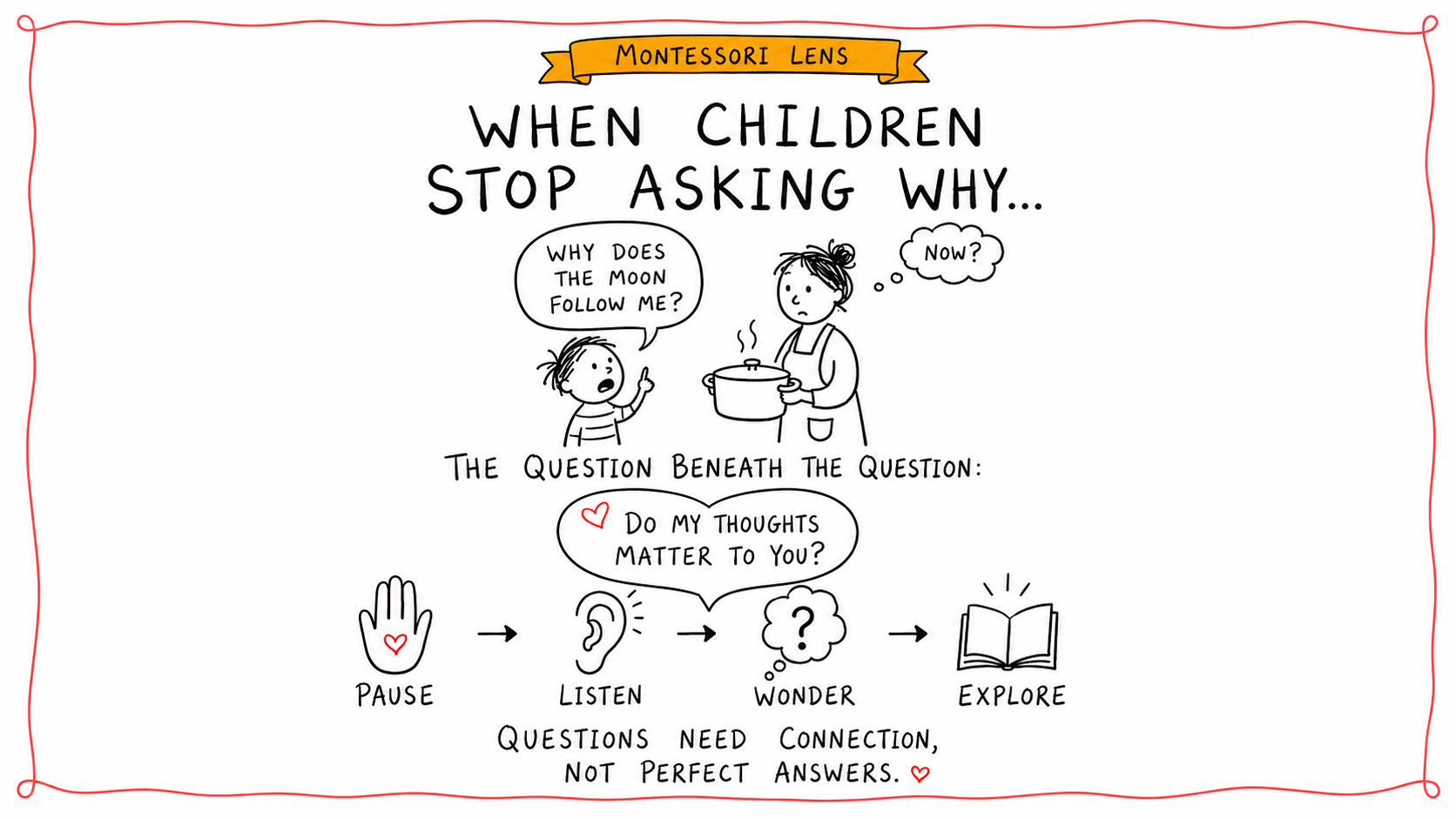
What happens when children stop asking “why”?
Your child’s question may sound like a request for information. Sometimes, it is really a request for connection.
Children have extraordinary timing.
They can sit quietly for twenty minutes while you are completely available.
But the moment the pasta boils over, the phone rings and someone announces that they cannot find their other sock, they will ask:
“Where was I before I was born?”
I looked at the saucepan.
I looked at my child.
“That is a very important question,” I said. “Please go and wash your hands.”
And just like that, the mystery of human existence was postponed until after dinner.
Except we never returned to it.
Dinner became dishes. Dishes became school bags. School bags became bedtime.
The question quietly disappeared.
Later, when the house was finally silent, it came back to me.
Not because I had failed to give the correct answer.
Because I had never asked what my child was really wondering.
Perhaps the question was not the whole question
When children ask us something, our adult brain immediately begins searching for an answer.
“Does the moon follow me?”
We are ready:
“No, it only appears that way because the moon is very far away.”
Correct? Absolutely.
Conversation over? Also yes.
But perhaps the child was not asking for an astronomy lesson.
Perhaps they were trying to express the strange and beautiful feeling that something enormous, distant and mysterious seemed personally connected to them.
What if we had said:
“It really does look as though it is following us. What do you think is happening?”
Suddenly, there is room for the child’s idea.
Maybe the moon is looking after the car.
Maybe it knows the way home.
Maybe it follows everyone—but feels as though it belongs only to them.
The theory may not be scientifically accurate. But for a moment, we are seeing the world through the child’s eyes.
And isn’t that where connection begins?
The quieter question beneath “why”
A child who asks, “Where was I before I was born?” may not only be asking about birth.
They may be wondering:
Was I always yours?
A child who asks, “Will you die one day?” may not be looking for a lesson about the life cycle.
They may be asking:
Will I be safe without you?
And a child who repeatedly asks, “Why?” may be asking something even quieter:
Do my thoughts matter to you?
Children can be surrounded by loving adults and still feel alone with their thoughts.
It happens gradually.
“You’re too young to understand.”
“Why do you ask so many questions?”
“That’s just how it is.”
“Not now.”
Every parent has said these things. I certainly have.
One hurried response does not destroy curiosity. We cannot stop everything whenever a philosophical question arrives beside the laundry basket.
But if children repeatedly feel that their questions are inconvenient, they may eventually stop bringing them to us.
Not because the wondering has ended.
Because they no longer expect anyone to wonder with them.
And that silence can be easily mistaken for maturity.
We may think:
Finally—the ‘why’ phase is over.
But perhaps the questions have simply moved somewhere we can no longer hear them.
The Montessori response is not another lesson
Montessori asks us to observe before we intervene.
Perhaps we can bring the same pause to children’s questions.
A child’s mind does not organise the world into separate school subjects.
A dead butterfly can lead to wings, flowers, seasons, death, families and whether insects feel sadness.
Rain can lead to rivers, oceans, clouds, maps and why some people do not have enough water.
To us, the child may appear to be jumping randomly from topic to topic.
But the child is building connections.
This is at the heart of Montessori Cosmic Education: the world is not a pile of unrelated facts. It is a web of relationships.
Our role is not to become a walking encyclopaedia.
It is to protect the curiosity that makes the child want to explore.
And, thankfully, that does not require a perfectly prepared Montessori presentation every time somebody notices an ant.
Sometimes it requires only four small actions.
Pause. Listen. Wonder. Explore.
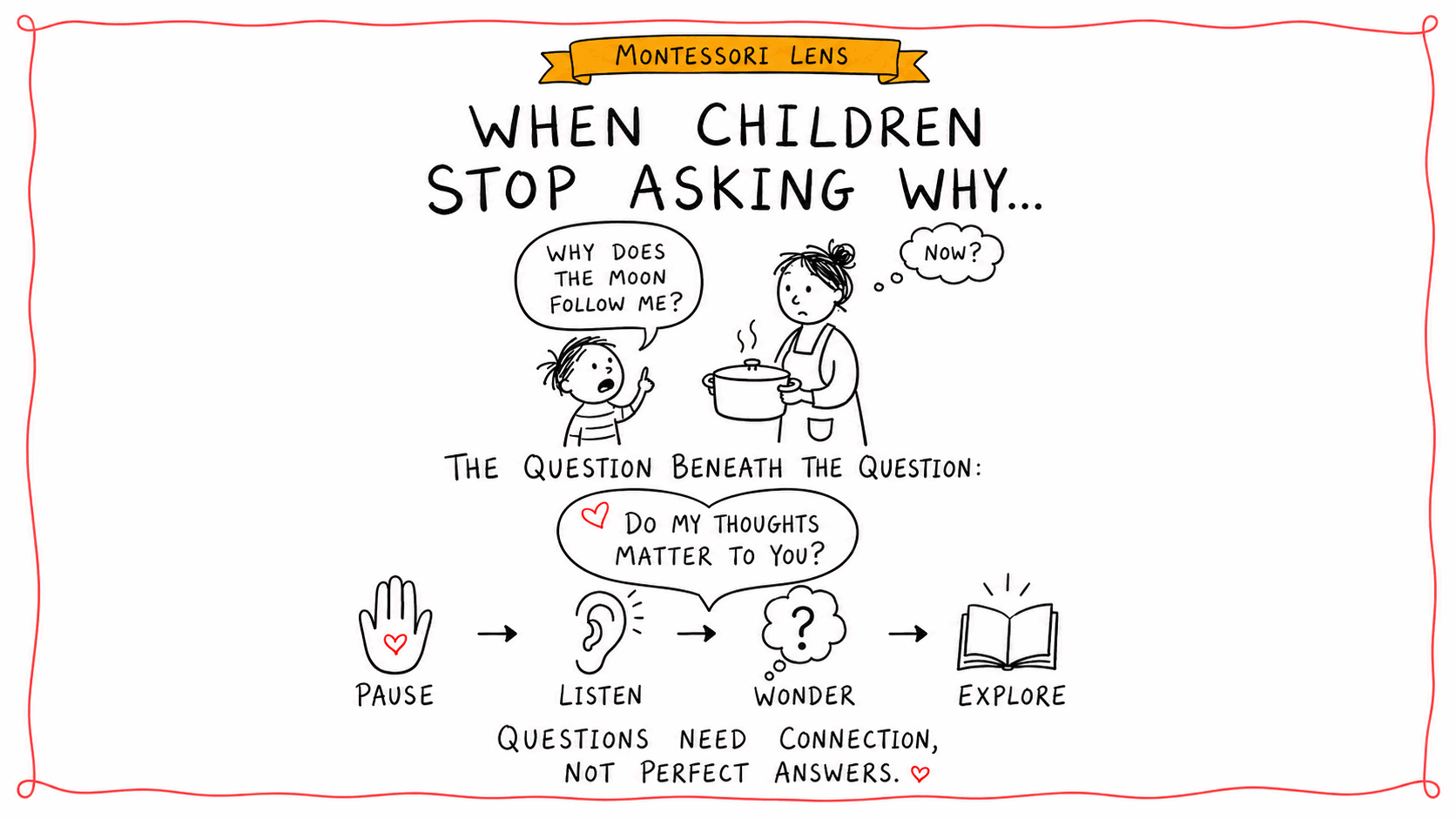
Pause before answering.
If you are busy, acknowledge the question:
“That deserves more time. Can we keep it for after dinner?”
The important part is returning to it.
Listen for what is underneath it.
Ask:
“What made you wonder about that?”
A question that sounds scientific may have begun with a worry, a dream or something heard at school.
Wonder before correcting.
Ask:
“What do you think?”
Let the child form a theory before you provide the facts. Their explanation shows you how their mind is working.
Explore only if the interest continues.
Find a book. Make a drawing. Observe outdoors. Try an experiment. Ask someone who knows more.
Or simply keep talking.
Not every question needs to become a worksheet.
Sometimes:
“I don’t know, but I would love to think about it with you”
is enough.
For the questions that arrive while the pasta is burning
Because big questions rarely wait for convenient moments, I created the free Pause, Listen, Wonder, Explore Parent Guide.
It is a simple two-page printable with:
-
ready-to-use phrases for moments when you are busy or unsure;
-
prompts to help you notice the question beneath the question;
-
space to record a question so it is not forgotten;
-
and a short reflection for the parent.
You can keep it on the fridge, near your family noticeboard or inside a parenting journal.
Instead of ending the conversation with “Not now,” you can say:
“That question deserves more time. Let’s write it down so we don’t lose it.”
You do not have to answer immediately.
You simply have to show the child that their question has somewhere safe to wait.
[Download the free Pause, Listen, Wonder, Explore Parent Guide]
We do not need all the answers
We will still be busy.
The pasta will still boil over.
Important questions will continue to arrive when we are carrying laundry, replying to messages and trying to remember what tomorrow’s lunch should be.
We will not always respond beautifully.
Montessori parenting is not about becoming perfectly calm, endlessly available or educationally prepared at every moment.
It is about noticing the child in front of us—and being willing to repair the moments we miss.
We can return later and say:
“You asked me something earlier. I’ve been thinking about it. What made you wonder about that?”
Imagine what that communicates to a child:
I remembered.
Your thought stayed with me.
What happens inside your mind matters to me.
The next time your child asks an enormous question, resist the urge to make it smaller.
You do not need the perfect answer.
Pause.
Listen.
Wonder.
And, if the child invites you, explore.
Because sometimes children are not looking for someone who knows everything.
They are looking for someone who will not leave them wondering alone.
A gentle invitation
Write down one question your child asks this week.
Return to it later and ask:
“What made you wonder about this?”
You may be surprised by the question hidden beneath the question.
What is the funniest, strangest or most unexpected question your child has asked you? Share it in the comments—because children’s questions deserve somewhere to land.