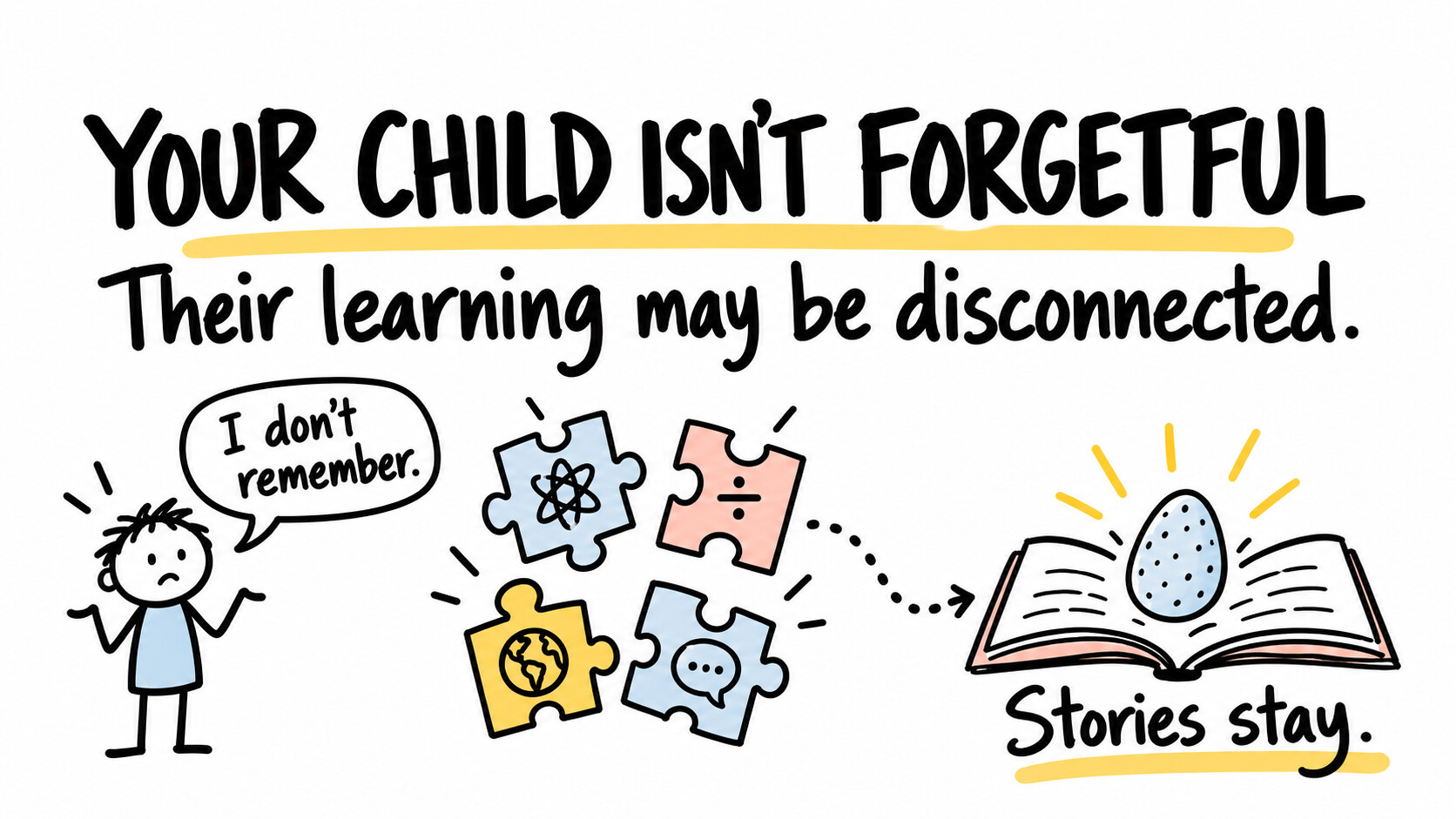
Your Child Isn’t Forgetful—Their Learning May Be Disconnected
Why children remember stories but struggle to recall yesterday’s lesson—and how cosmic storytelling can help.
“What did you learn at school today?” “Nothing.”
It is probably one of the most familiar—and frustrating—conversations between parents and children. Nothing?
They spent most of the day in school. Their bag is heavy enough to contain several encyclopaedias. Surely something happened? So we try again.
“What did you do in science?” “I don’t remember.”
“What about maths?” A shrug.
Yet the same child can retell a story heard weeks ago with remarkable accuracy.
They remember the mysterious egg, who discovered it, what colour it was and exactly what happened when it cracked.
This often leaves us wondering: Is my child not paying attention?
Is their memory weak? Do they need more revision?
But sometimes, the problem is not the child’s memory.
The learning may have arrived as too many disconnected pieces.
Imagine learning without seeing the picture.
Imagine being given a puzzle one piece at a time. On Monday, you receive a blue piece.
On Tuesday, a curved piece. On Wednesday, something that might belong to an animal.
You are expected to study and remember every piece—but nobody shows you the picture on the box. This can be how learning feels to a child.
Whales belong to science. Oceans belong to geography. Measurement belongs to maths. New words belong to language. Each subject is placed in a different book, lesson and part of the day. But the real world does not work that way.
A whale does not stop being part of geography when the science lesson begins. Its enormous length is mathematical. Its migration involves distance, maps and climate. Its communication opens the door to sound and language. Its place in the ocean reveals a whole web of relationships.
The world is connected—and children naturally look for those connections.
What is cosmic storytelling?
Cosmic storytelling is rooted in Montessori Cosmic Education.
It introduces children to a larger idea through an engaging, fact-based story. From that story, different areas of learning begin to unfold naturally.
Instead of saying: “Today we will learn five facts about whales,” we might begin with: “Deep beneath the ocean lives a giant. It travels across enormous distances, depends on some of the smallest life in the sea—and quietly helps feed the ocean around it.”
Now the child has questions.
What is the giant?
How far does it travel?
How can something so enormous depend on something microscopic?
How does it help the ocean?
One story has opened the door to science, geography, maths and language. That is the heart of cosmic storytelling. It does not simply make a lesson more entertaining. It gives knowledge a meaningful place to belong.
Facts give children answers. Stories give them questions.
Tell a child: “A blue whale can grow to around 30 metres.”
They have received a fact.
Now ask:
“Could a blue whale fit inside our house?” Suddenly, the child begins to imagine.
“How many rooms long would it be?”
“Would it fit on our street?”
“Is its heart bigger than me?”
“Why does such a huge animal eat such tiny creatures?”
The child has moved from receiving information to actively thinking about it. That shift matters. In a world where children can search for almost any answer within seconds, their real advantage may not come from memorising the largest number of facts. It may come from knowing how to:
- ask meaningful questions;
- notice patterns;
- connect different ideas;
- judge whether an answer makes sense;
- and remain curious enough to investigate further.
What makes cosmic storytelling different?
A carefully prepared cosmic story:
- begins with wonder rather than a definition;
- presents the bigger picture before the smaller details;
- connects learning across subjects;
- uses imagination while remaining factually grounded;
- leaves room for children’s own questions;
- and continues through drawing, mapping, measuring, reading, discussion or research.
The story is not the complete lesson. It is the spark that makes the child want to continue.
How can parents try this at home?
You do not need Montessori training, special materials or a theatrical storytelling voice. Start with a few small changes.
Ask what surprised them
Instead of asking only, “What did you learn?”, try:
- “What surprised you today?”
- “Did anything make you curious?”
- “What question stayed in your mind?”
- “Did something connect with something you already knew?”
These questions feel less like a test and give children more ways to talk about their day.
Begin with a mystery
Instead of announcing: “Today we are learning about whales,” ask: “What could one whale possibly do for an entire ocean?” Allow some unusual theories before looking for the answer. Curiosity grows in the space before the explanation.
Follow one interest in several directions
If your child becomes fascinated by whales, you could:
- locate the oceans on a map;
- measure 30 metres outside;
- compare a whale with a bus;
- listen to whale communication;
- draw an ocean food web;
- collect interesting ocean words;
- or choose a book that answers one of their questions.
You do not need to label each activity as maths, science or geography. The connections are already there.
Resist answering immediately
When your child asks a question, pause before reaching for Google. Ask: “What do you think might be happening?” Their theory does not have to be correct. It allows you to see how they are reasoning—and gives them the experience of thinking before receiving an answer.
Sometimes children do not need more information
When a child forgets something, our instinct is often to add more:
More revision.
More worksheets.
More explanation.
But sometimes the child does not need another puzzle piece.
They need to see the picture.
Cosmic storytelling shows children that knowledge is not a collection of unrelated subjects stored in separate books. It is a living network of relationships.
When children begin to see those relationships, learning feels less like something they must remember—and more like something they genuinely want to understand.
Beginning with one whale
This idea is at the heart of my upcoming online cosmic storytelling workshop:
The Whale Who Feeds the Ocean
Designed for children aged 5–10, this 45-minute live session begins with one whale—but does not remain inside a single subject. Through storytelling, conversation, questions and sketchnoting, children will explore connections with:
- Maths
- Science
- Language
- Geography
They will not simply collect facts about whales. They will discover how one enormous animal connects with some of the smallest living organisms in the ocean—and why that relationship matters. Each session is limited to 10 children, allowing everyone space to respond, wonder and share.
The workshop also includes follow-up activity sheets, supporting materials and curated book recommendations so that the exploration can continue after the session.
Register your interest: https://forms.gle/mYocbs99BZ29CYAa6
For enquiries: montessoriparentinghub@gmail.com
Because the best learning does not always end with: “Now I know the answer.”
Sometimes it ends with: “I have another question.”
Parents and teachers: Have you noticed a child making an unexpected connection between two completely different subjects?
What were they trying to understand?
Share it in the comments—their question may reveal more learning than their answer.