
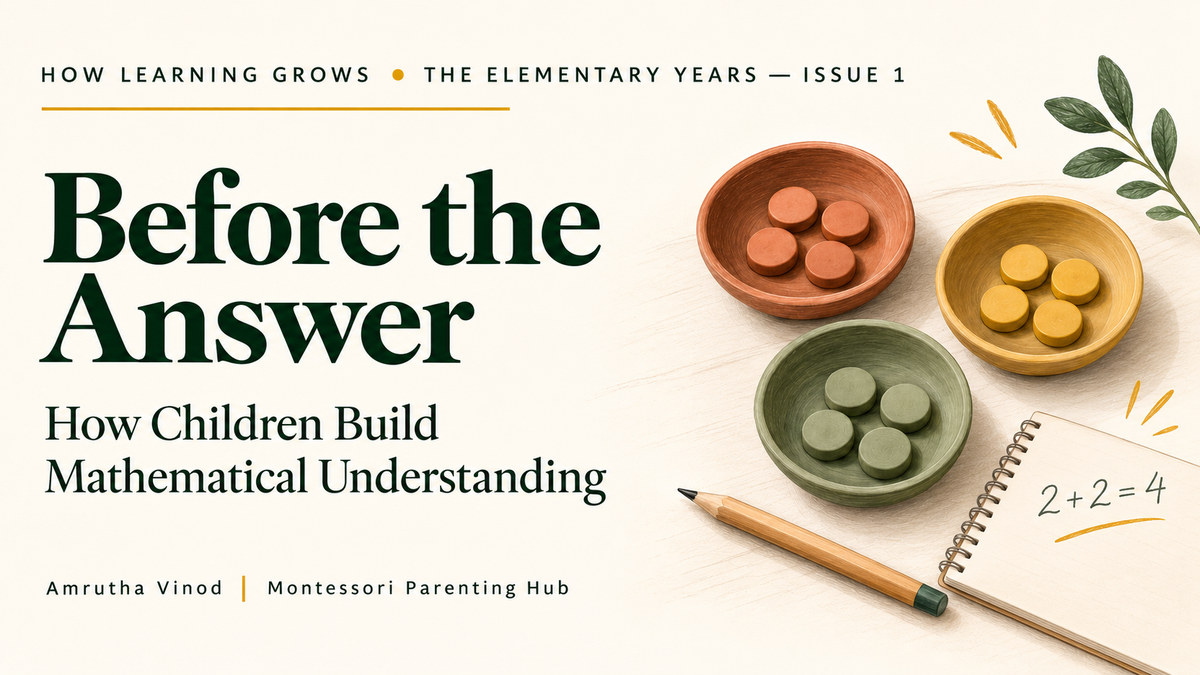
Before the Answer: How Children Build Mathematical Understanding
How Learning Grows: The Elementary Years — Issue 1
Your child says, “The answer is four.”
You say, “Well done.” But what could you ask next?
“How did you work it out?”
That small question can open a window into your child’s thinking. Perhaps they counted objects, remembered a number fact, drew a picture or noticed a pattern. Their explanation tells us something the answer alone cannot.
In this series, we’ll explore how learning develops across the elementary subjects—and how parents can support it through everyday experiences. We begin with mathematics, where a handful of objects can lead to surprisingly rich discoveries.
How does an action become an idea?
Place 12 counters and three bowls on a table.
Ask your child:
“Can you share these equally between the three bowls?”
They might distribute the counters one at a time. They might place several in each bowl and adjust the amounts. Let them choose their approach.
Once they finish, ask:
“How can you check that the shares are equal?”
Each bowl contains four counters. But there is much more to notice: the total remains 12, there are three equal groups, and each group contains four.
The written calculation 12 ÷ 3 = 4 now describes something the child has experienced.
A learning flow parents can recognise
One useful way to follow the development of understanding is:
Explore → Describe → Represent → Record → Apply
Explore: Handle objects and investigate a question.
Describe: Explain what happened, using everyday language.
Represent: Draw or arrange something that makes the thinking visible.
Record: Connect the experience to mathematical symbols.
Apply: Use the idea in another situation and explain why it works.
This is a flexible pathway. A child may write a calculation and then return to objects to check it. Another may understand an arrangement before finding the words to explain it.
Returning to materials can be part of thinking deeply.
The Montessori connection
In a Montessori approach, mathematical materials give children ways to examine relationships through their hands and eyes.
Beads, number cards and other carefully designed materials help make quantities, place value and operations visible. As children become familiar with these relationships, they can connect their actions to written calculations and increasingly work with the ideas mentally.
At home, ordinary objects can support a small investigation too. The purpose is to give your child something they can arrange, question and explain.
One number, many discoveries
Try this short activity together.
You’ll need: 12 counters or small blocks, four bowls, paper and a pencil.
1. Share
“Share 12 counters equally between three bowls.”
Then ask:
- How did you decide where to put them?
- How do you know the shares are equal?
- Can you draw what you made?
2. Predict
“Suppose we use four bowls instead. Will each bowl have more counters or fewer? Why?”
Give your child time to predict before rearranging the counters.
3. Change the question
“Now make groups of three counters. How many groups can you make?”
Notice the difference: sharing between three bowls asks how many go in each group; making groups of three asks how many groups can be made. Both involve division, but the questions mean different things.
4. Investigate further
“Which other equal groups can you make with 12?”
Children ready for more challenge can try 24 objects and find all possible equal groupings. Ask:
“How could you organise your discoveries so that you don’t miss any?”
What should you notice?
Listen for the reasoning beneath the answer.
Can your child explain why the groups are equal? Predict what will change? Connect their drawing to a calculation? Notice that three groups of four make 12, linking division with multiplication?
If explaining is difficult, invite them to show you with the objects. Their actions may reveal thinking they cannot yet express in words.
A resource worth saving
Difficulties With Division — NRICH, University of Cambridge
This article explores sharing, grouping and connections with multiplication. It offers useful background for adults who want to understand the ideas beneath division.
One question to carry into the week
The next time your child gives an answer, try asking:
“Can you show me why that works?”
You may discover a strategy you hadn’t expected—or a question worth exploring together.
Next in the series: Geometry—how exploring shapes grows into reasoning about their relationships.
Amrutha Vinod Montessori Parenting Hub